Batwara 1947 — A touching Partition drama that delivers a powerful message of humanity, love and brotherhood through heartfelt performances.

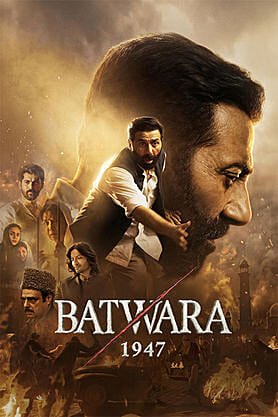
Cast: Sunny Deol, Preity Zinta, Shabana Azmi
Writer: Rajkumar Santoshi
Director: Rajkumar Santoshi
Producers: Aamir Khan, Rajkumar Santoshi
Rating: ⭐⭐⭐/5
Batwara 1947, released around Independence Day, is a poignant period drama that revisits one of the darkest chapters in Indian history — the Partition of 1947. Rather than relying heavily on spectacle or political commentary, the film chooses to focus on ordinary people, their shattered homes, relationships, fears and their struggle to hold on to humanity during times of hatred.
Story & Screenplay
The story follows families caught in the turmoil of Partition, where borders are suddenly drawn and people are forced to leave behind everything they know. At the heart of the narrative is the emotional conflict between Sikander Mirza and his family and an elderly Hindu woman, Mai, who refuses to leave her ancestral home in Lahore.
The premise creates an intimate look at displacement, loss, communal tension and unexpected human connections. The screenplay works best when it remains personal, showing how political decisions can completely transform the lives of common people.
At times, the narrative feels deliberately slow, but that slower pace allows the emotional moments to breathe.
Performances
Sunny Deol delivers a restrained and mature performance as Sikander Mirza. Unlike his more aggressive screen personas, his character here is driven largely by vulnerability, responsibility and compassion.
Shabana Azmi is outstanding and brings tremendous emotional depth to Mai. Her scenes carry some of the film’s strongest moments.
Preity Zinta makes an effective comeback, bringing warmth and sincerity to her character. Karan Deol and Ali Fazal also make their presence felt, adding further layers to the story.
Direction
Rajkumar Santoshi handles the subject with sensitivity. The film doesn’t simply portray Partition through violence; instead, it examines the human cost of displacement and communal hatred.
The decision to focus on relationships and humanity gives the film an emotional identity of its own.
Music & Songs
The music by A.R. Rahman, with lyrics by Javed Akhtar, complements the period setting and emotional tone. Rather than overpowering the narrative, the songs and background score are used to strengthen the film’s atmosphere and emotional moments.
Cinematography
Santosh Sivan’s cinematography is one of the film’s visual strengths. The period setting, refugee landscapes and interiors are captured with an earthy, authentic visual style. The camera often allows the emotions of the characters to take centre stage instead of turning the historical backdrop into mere spectacle.
Production
Produced by Aamir Khan and Aparna Purohit, the film has clearly invested in recreating the atmosphere of the Partition era. The production design and period detailing help establish the world in which the characters live and struggle.
Conclusion
Batwara 1947 is ultimately less about the politics of Partition and more about the people who suffered because of it. Its strongest moments come when it talks about kindness, compassion, family and brotherhood in the middle of hatred.
The film may not be a perfect or consistently gripping historical drama, but its emotional core is sincere and impactful. Sunny Deol and Shabana Azmi deliver memorable performances, while the film’s message of humanity gives it relevance beyond its historical setting.
Verdict: A touching Partition drama that chooses humanity over hatred.
Rating: ⭐⭐⭐/5